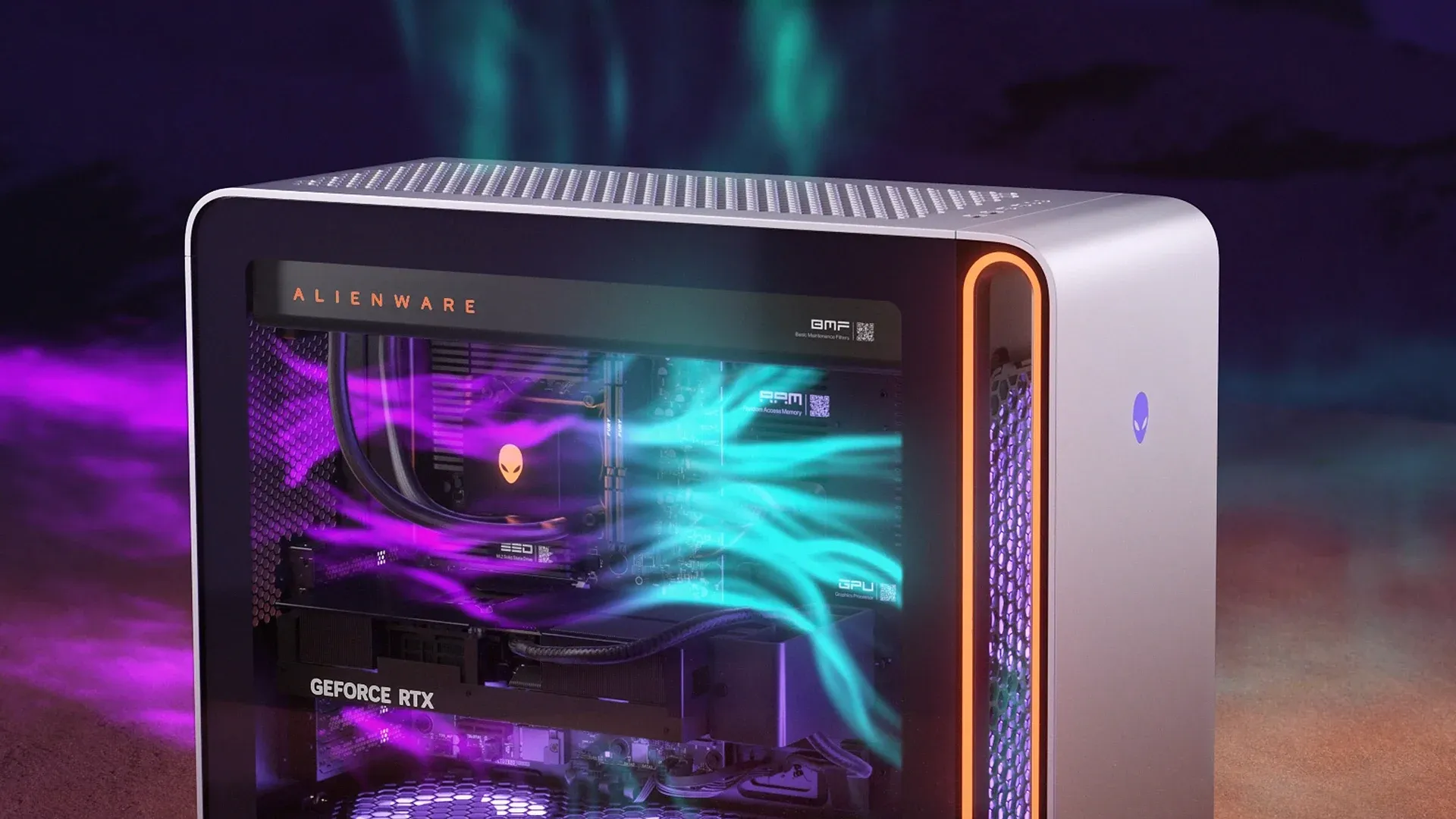
Alienware has officially signaled the end of the “compact” gaming PC trend with the 2026 refresh of the Area-51. Unveiled at CES, this desktop is an unapologetic exercise in excess, abandoning the space-saving compromises of the Aurora line for a massive 80.5-liter chassis. The headline here is not just the aesthetic return to the triad design, but the thermal capacity required to house the industry’s hottest silicon: the AMD Ryzen 7 9850X3D and NVIDIA’s 32GB RTX 5090.
Thermals and The Positive Pressure Design
The sheer scale of the chassis—measuring 610.5mm in length and weighing a back-breaking 34.5kg (76 lbs)—is functional rather than purely cosmetic. Alienware has implemented a positive pressure airflow architecture, where intake fans force cool air into the case faster than it can escape, pushing heat out through passive rear vents. The company claims this configuration reduces operating temperatures by 13 percent and noise levels by 45 percent compared to the previous generation, a necessary engineering feat to manage a system with a potential power draw exceeding 1000 watts.

Related Post




Silicon: The X870E Foundation
Internally, the system is built around the AMD X870E chipset, providing the PCIe Gen5 bandwidth necessary for next-generation storage and graphics. Processor options top out at the 16-core AMD Ryzen 9 9950X3D, though the Ryzen 7 9850X3D will likely be the sweet spot for pure gamers due to its optimized 3D V-Cache layout. These chips are fed by a voltage regulation module (VRM) utilizing a 10+2+2 phase design, ensuring stability under sustained heavy loads.
However, we noticed a potential bottleneck in the memory specifications. The system currently lists a maximum supported configuration of 64GB DDR5-6400. For a machine of this caliber, specifically one targeting the workstation crossover market, capping RAM at 64GB feels restrictive when enthusiast motherboards often support 128GB or 192GB.
Graphics and Power Delivery
The visual heavy lifting is managed by NVIDIA’s RTX 50-series, ranging from the RTX 5070 up to the flagship RTX 5090. The chassis supports cards up to 450mm in length and four slots in width, effectively future-proofing it against the ever-expanding size of GPU coolers. Power is delivered via proprietary ATX12VO units, available in 850W Gold or 1500W Platinum ratings. While ATX12VO is more efficient than standard ATX supplies, its proprietary nature means replacing the power supply unit (PSU) down the line will be difficult, locking users into the Dell/Alienware ecosystem.
Storage and Expansion
For storage, the Area-51 offers three PCIe M.2 slots and three additional bays for legacy 2.5-inch or 3.5-inch drives, allowing for a total factory capacity of 12TB. Cooling duties are handled by AIO liquid solutions, with 240mm and 360mm radiator options available at purchase, and room for a 420mm expansion for aftermarket modders. Connectivity is robust, featuring MediaTek Wi-Fi 7, Bluetooth 5.4, and 2.5G Ethernet, alongside the mandatory USB4 Type-C ports for high-speed peripherals.
Pricing and Market Reality
Alienware has not confirmed final pricing, but based on the component costs of the RTX 5090 and Ryzen 9000 series, we expect the base models to start around $2,800, with the top-tier configurations easily exceeding $5,500.
The Daily Tech Lens Verdict
The Alienware Area-51 is a statement piece for buyers who refuse to compromise on frame rates or desk space. The inclusion of the Ryzen 9850X3D and RTX 5090 makes it arguably the fastest pre-built machine announced for Q1 2026. However, the proprietary motherboard and power supply ecosystem remains a significant drawback for right-to-repair advocates. If you buy this 76-pound tower, plan on keeping it intact for its entire lifecycle, because upgrading it piece-by-piece will be a challenge.