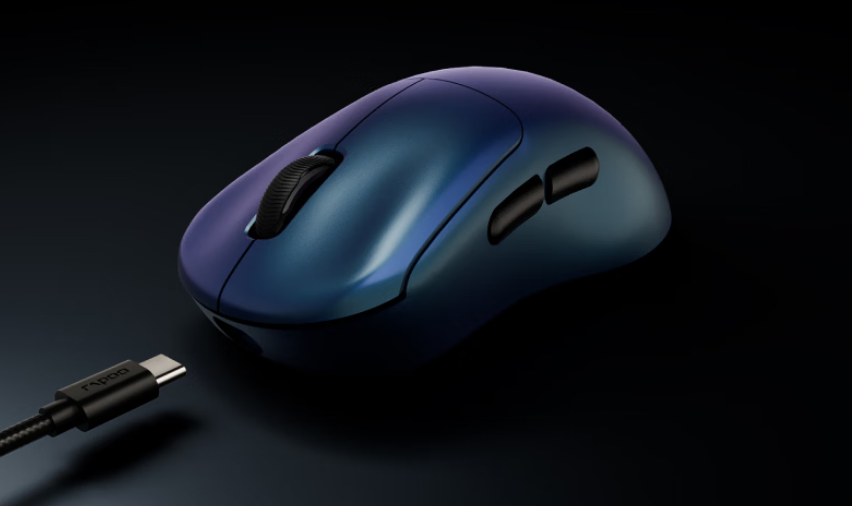
Rapoo is pushing competitive grade wireless performance deeper into the affordable tier. The company has launched the VT3s Max Master Edition in China with preorders priced at 499 yuan, or about $72, and the headline feature is native 8K polling over 2.4GHz wireless, a spec that was previously limited to higher priced esports mice.
What separates the VT3s Max from typical wireless designs is its dual chipset approach. Rapoo says it uses two Nordic 54H20 chips, one inside the mouse and another inside the nano receiver, both running at 320MHz on a 22nm process. The goal is to deliver 8K wireless polling with low latency and stronger resistance to interference, while also improving efficiency through Rapoo’s V plus Wireless 2.0 link.

Related Post





The sensor is also positioned as a flagship class component. Rapoo equips the VT3s Max Master Edition with the PixArt PAW3950 Ultimate sensor, which the company says supports 10 to 45,000 DPI in 0.1 step increments, up to 750 IPS tracking, and 50G acceleration. Rapoo also highlights independent X and Y tuning, adjustable lift off distance from 0.7mm to 1.7mm across 11 levels, glass surface tracking, and scan rates above 20,000 FPS in a competitive mode designed for high speed input.
Rapoo is leaning into optical components to reduce mechanical wear. The VT3s Max uses an optical input system with custom tuned optical micro switches rated for 120 million clicks, along with a Rayenc optical scroll encoder rated for 2 million cycles. Optical switches have become more common in esports mice because they avoid double click issues and tend to stay consistent longer, though the real world feel depends heavily on tuning.
Connectivity covers both wired and wireless use. The VT3s Max supports USB C wired mode and 2.4GHz wireless mode and ships with an 8K capable nano receiver that includes LED indicators. Power comes from an 800mAh battery with fast charging, and Rapoo claims a one minute charge can deliver up to four hours of use. Battery life is rated up to 450 hours at 1,000Hz polling and about 75 hours at 8,000Hz, figures that underline the tradeoff between peak responsiveness and endurance.
The physical design targets small to medium hands and is built around an asymmetric ergonomic shell intended for palm and claw grips. Rapoo mentions finger grooves, a slimmer waist for control, eight programmable buttons with onboard memory, and configuration through its A Hub software on Windows and macOS. The base uses high purity PTFE feet rated at 99.95% Teflon, aiming for smoother glide and more predictable stopping.
Rapoo’s timing matters because mainstream brands are also refreshing their value wireless lineups. Logitech recently introduced the G304 X with a 57g build, a Hero 25K sensor, and up to 106 hours of battery life, showing that the budget segment is increasingly defined by sensor quality and weight rather than just price.
We see the VT3s Max Master Edition as a signal that 8K wireless is starting to trickle down from niche esports hardware into more accessible products. Most players will not feel a night and day difference jumping from 1,000Hz to 8,000Hz, especially in games limited by system latency, display refresh, and network conditions. Still, a $72 mouse offering native 8K wireless, optical switches, and a high end sensor puts pressure on the rest of the market, and it gives competitive players a lower cost path to the same top line specs they typically pay far more to get.