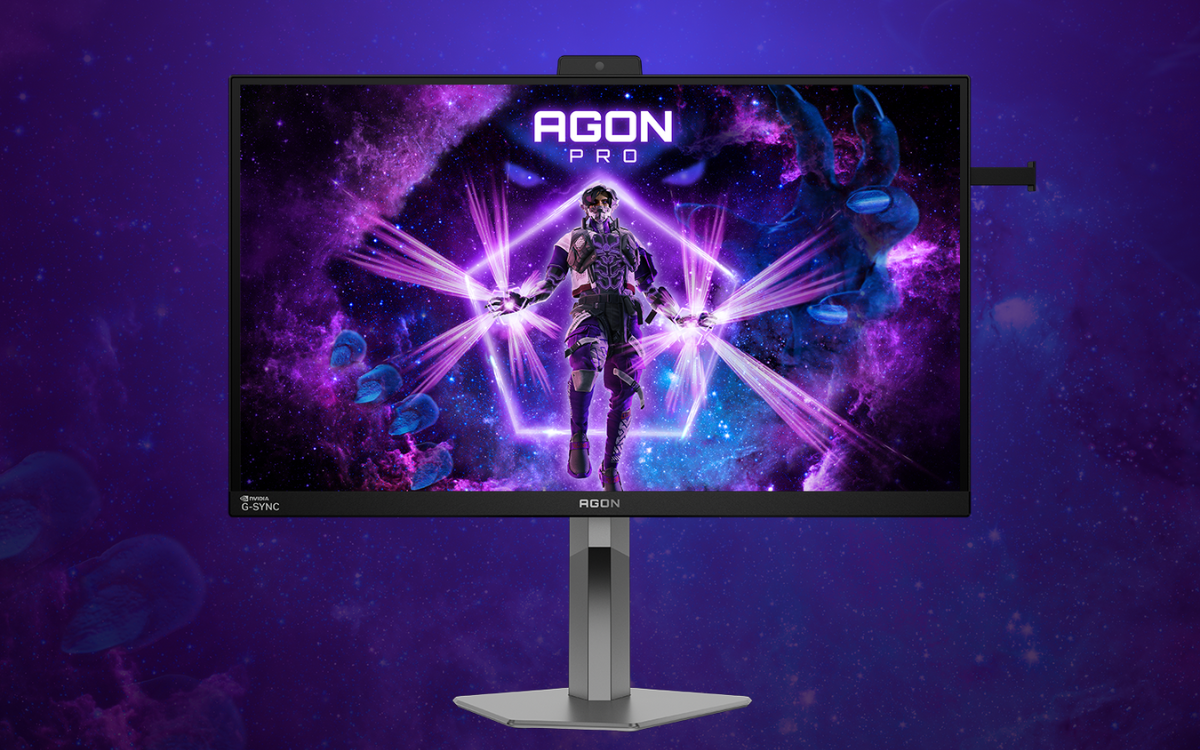
The dedicated hardware G-Sync module has become a rarity in 2026, often discarded by manufacturers to cut costs, but AOC is reviving it for a specific purpose: perfecting motion clarity. The newly launched Agon Pro AG276QSG2 is not just another high-refresh rate slab; it is one of the first monitors to fully leverage Nvidia’s G-Sync Pulsar technology. By integrating this hardware, AOC claims to solve the historic trade-off between variable refresh rates (VRR) and backlight strobing, potentially offering motion clarity that rivals 480Hz panels while running at a “modest” 360Hz.
Context: IPS Strikes Back at OLED
For the past two years, OLED panels have dominated the high-end gaming conversation due to their near-instant pixel response times. However, for strictly competitive players—those grinding Counter-Strike 2 or Valorant—OLEDs often suffer from brightness limitations during Black Frame Insertion (BFI). The AG276QSG2 positions itself as the counter-argument. By using a Fast IPS panel, it maintains higher brightness levels while utilizing the new Pulsar tech to strobe the backlight in sync with the variable refresh rate. This allows for tear-free gaming with the crisp visual persistence usually reserved for CRT monitors or fixed-refresh setups.

Related Post




Specifications: Speed Over Contrast
The chassis houses a 27-inch Fast IPS panel running at a resolution of 2560 x 1440 (QHD). While the headline feature is the 360Hz refresh rate, the critical metric is the response time. In standard operation, the monitor delivers a 1ms gray-to-gray transition, but with the strobing mode engaged, AOC claims an effective response time of 0.69ms. This sub-millisecond performance is achieved by “G-Sync Pulsar,” which modulates the overdrive pixel-by-pixel to prevent the ghosting artifacts that typically plague strobed IPS panels.
Color performance remains standard for this bracket, covering 100 percent of sRGB and 90 percent of the DCI-P3 gamut. The display is factory calibrated with a Delta E variance below 2, ensuring that the team jerseys look correct on screen. Peak brightness hits 500 nits in HDR mode, which is serviceable for competitive visibility but falls short of true HDR cinematic experiences. AOC has also included “G-Sync Ambient Adaptive” technology, utilizing a built-in sensor to adjust color temperature based on room lighting—a feature borrowed from the mobile and creative professional markets.
Connectivity is robust, featuring two HDMI 2.1 ports and a single DisplayPort 1.4 with Display Stream Compression (DSC). A USB 3.2 hub provides upstream support for peripherals, and a micro USB port is present specifically for firmware maintenance.
Pricing and Market Position
AOC has confirmed a global launch price of $599.99. This is a strategic price point. In the Chinese domestic market, the unit sells for 4,999 yuan (approx. $716), suggesting that AOC is aggressively subsidizing the international MSRP to undercut the wave of affordable 27-inch OLEDs currently flooding the market at the $650-$700 mark.
The Daily Tech Lens Verdict
The AOC Agon Pro AG276QSG2 is a specialized tool, not a generalist entertainment screen. If you play atmospheric single-player RPGs, a similarly priced Mini-LED or entry-level OLED will offer superior contrast and blacks. However, if your primary metric for quality is headshot consistency, this monitor justifies its existence. The inclusion of a physical G-Sync module for $600 is a significant value add in 2026, providing a level of motion handling that software-compatible “G-Sync Compatible” displays simply cannot match.