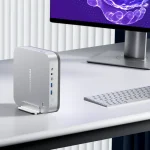
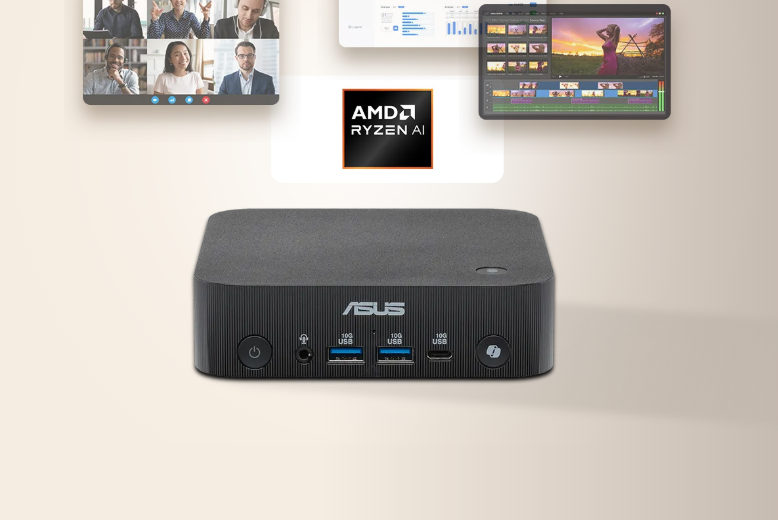
The industry obsession with the “Copilot+ PC” label has largely been confined to laptops, but ASUS is officially bringing that branding—and the dedicated keyboard button to match—to the commercial desktop market. Unveiled at CES 2026, the ASUS ExpertCenter PN55 represents one of the first ultra-compact workstations designed explicitly around Microsoft’s local AI requirements. While the form factor mimics the now-defunct Intel NUC, the silicon inside signals a clear shift toward AMD’s neural processing architecture for the enterprise sector.
Silicon and Neural Processing
The centerpiece of the PN55 is the AMD Ryzen AI 9 HX 470, a processor that pushes the thermal envelope of the mini PC format with a configurable TDP between 40W and 45W. For organizations with lighter workloads, ASUS offers scaled-down configurations with the Ryzen AI 7 445 or Ryzen AI 5 430. The critical metric here is the Neural Processing Unit (NPU), which delivers up to 55 TOPS (Trillions of Operations Per Second). This figure clears the hardware hurdle required to run Microsoft Copilot and real-time voice processing locally, theoretically reducing latency and cloud dependency for sensitive corporate data.

Related Post




The Memory Bottleneck
Despite the “AI” marketing, we have identified a significant hardware contradiction in the spec sheet. The system supports DDR5-5600 SO-DIMM memory but reportedly maxes out at 32GB across two slots. In an era where local Large Language Models (LLMs) and heavy multitasking demand massive memory pools, capping a “Pro” machine at 32GB feels like an arbitrary limitation. For context, competitors in the compact workstation space typically support at least 64GB or 96GB to accommodate virtualization and heavy data sets. Storage is handled by a standard PCIe 4.0 NVMe M.2 2280 slot, supporting up to 2TB drives.
Connectivity and the “Copilot Button”
The chassis, measuring a scant 130 x 130 x 34 mm, is dense with I/O. The front panel features the aforementioned dedicated Copilot button—a physical shortcut that Microsoft is pushing hard this year—alongside a fingerprint reader for biometric security.
Rear connectivity is robust for IT administrators. It includes dual 2.5G Ethernet ports on select models, a crucial feature for network segmentation or failover setups. Wireless duties are managed by the latest Wi-Fi 7 standard and Bluetooth 5.4. Display output is versatile, utilizing a USB 4.0 Type-C port (with DisplayPort 2.1), HDMI 2.1, and two dedicated DisplayPort 1.4 outputs, allowing the tiny box to drive a quad-monitor setup without external splitters.
Pricing and Market Positioning
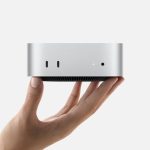
ASUS has not yet confirmed the MSRP for the US market. However, based on the cost of the Ryzen AI 9 silicon and previous ExpertCenter pricing structures, we estimate the barebone units (no RAM/SSD) will start around $550, with fully configured enterprise models reaching into the $850-$950 range. This pricing places it in direct competition with the Apple Mac Mini M4/M5 base models, though ASUS holds the advantage of user-serviceable storage and a wider array of legacy ports.
The Daily Tech Lens Verdict
The ASUS ExpertCenter PN55 is a competent evolution of the office desktop, packing impressive CPU power into a military-grade tested enclosure. However, the decision to cap RAM at 32GB undermines its positioning as an “AI Powerhouse.” Local AI needs memory bandwidth and capacity; without it, that 55 TOPS NPU is largely waiting for software that can fit in the cramped quarters. We recommend this unit for general fleet deployment where desk space is premium, but heavy data users should look for hardware with a higher memory ceiling.