Key Takeaways
- The Power: Packs a serious punch with the Ryzen AI 9 HX 370, capable of handling intensive multitasking and AI workloads with ease.
- The Limitation: Integrated graphics are good for casual play, but serious 4K gaming demands an external GPU via the OCuLink port.
- Best For: Linux enthusiasts and developers who need a compact powerhouse that’s ready to game when docked to an eGPU.
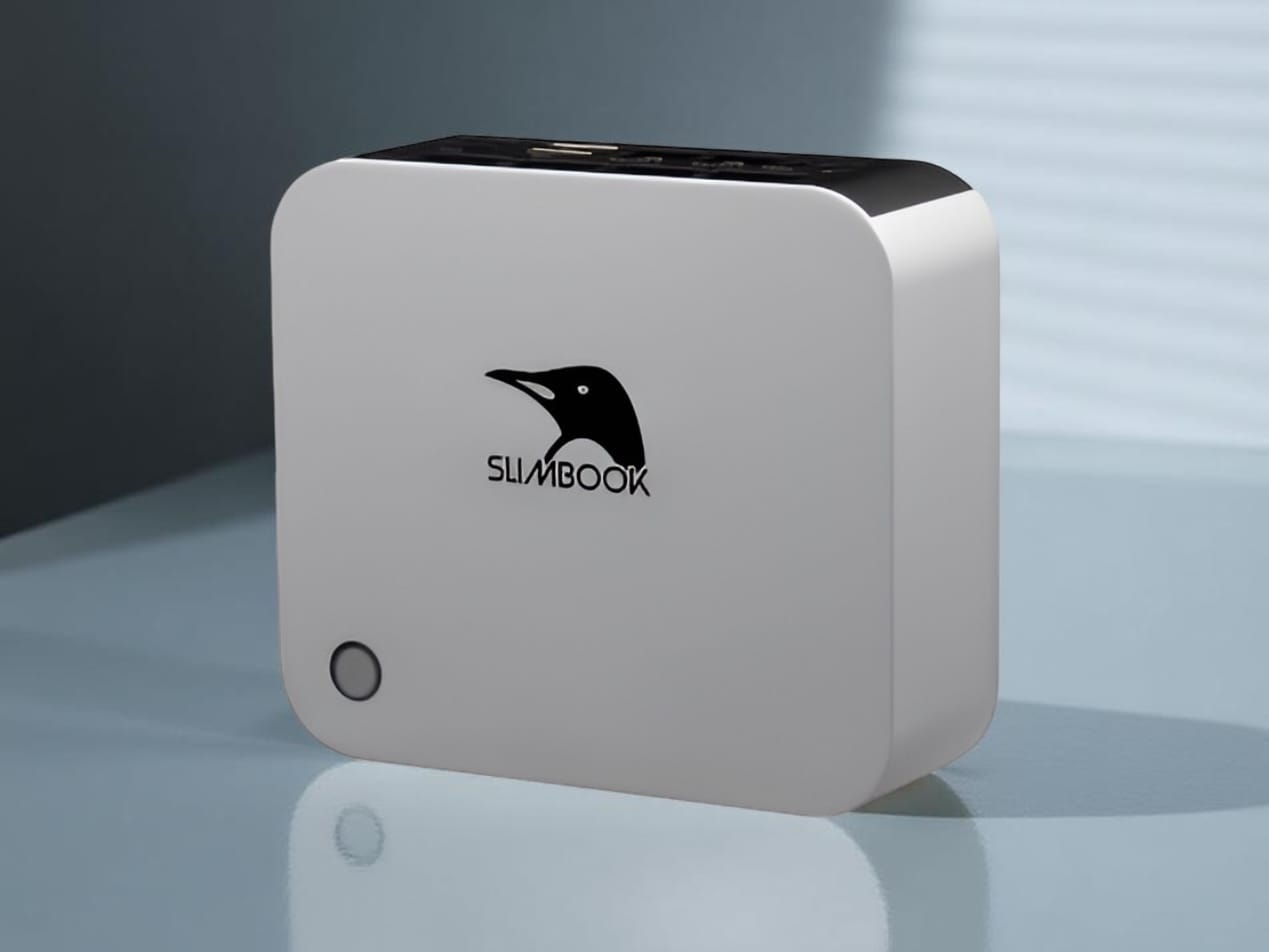
The landscape of Linux-first hardware just got significantly more interesting. Slimbook has unveiled the Slimbook One, a mini PC that refuses to compromise on performance despite its diminutive stature.
This isn’t just another office box; it’s a compact powerhouse designed to run Linux right out of the box. With top-tier silicon and expandable graphics support, it targets users who need serious computing power without the bulk of a traditional tower.

Related Post




The Heart of the Machine: Zen 5 Architecture
At the core of the premium model lies the AMD Ryzen AI 9 HX 370 APU. This 12-core processor, built on the cutting-edge Zen 5 architecture, is designed to chew through heavy workloads.
Whether you are compiling code or running complex simulations, the processing power here is substantial. It is paired with dual SO-DIMM slots supporting up to 128 GB of DDR5-5600 memory, ensuring that memory bottlenecks are virtually non-existent for most users.
For those with a tighter budget, a variant featuring the 8-core Ryzen 7 H 255 (Zen 4) is available. While less powerful, synthetic benchmarks suggest it still delivers about 85% of the performance of its pricier sibling, making it a viable option for standard productivity.
Graphics: Integrated vs. OCuLink
The chassis is too compact for a dedicated internal graphics card, relying instead on integrated solutions. The high-end model sports the Radeon 890M, while the base model uses the Radeon 780M.
The Radeon 890M offers a solid 20% to 30% performance boost over the 780M. This means you can comfortably enjoy casual gaming or esports titles at decent frame rates without additional hardware.
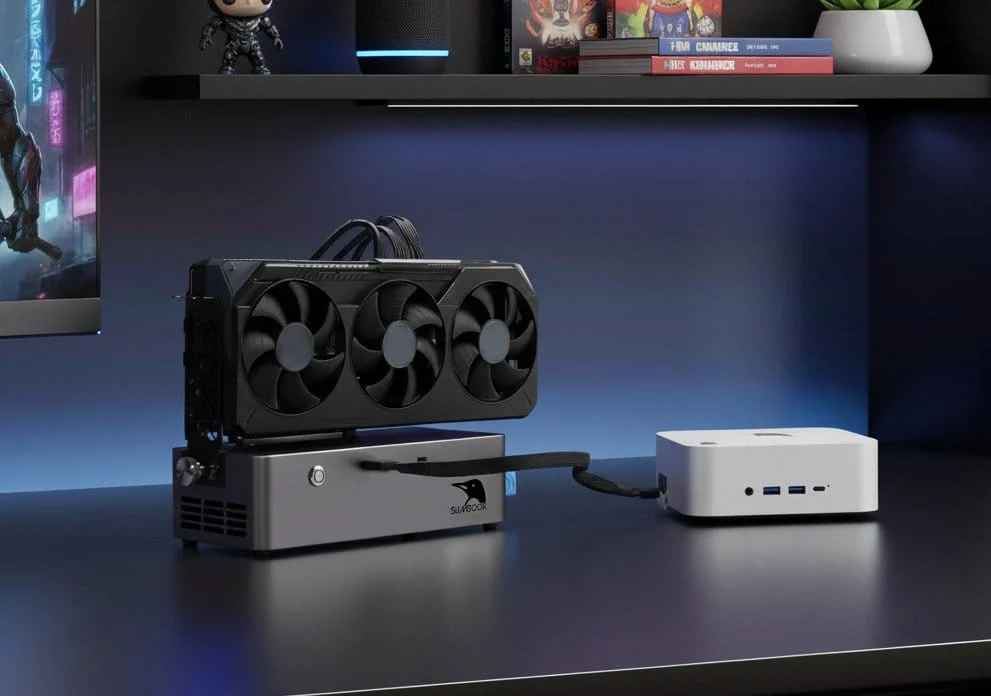
However, the real magic lies in the OCuLink port. This feature allows you to connect an external GPU (eGPU) with minimal bandwidth loss compared to Thunderbolt.
If you plan to play the latest AAA titles at high settings or perform heavy 3D rendering, this port transforms the Slimbook One from a capable mini PC into a full-blown gaming rig.
Connectivity and Storage
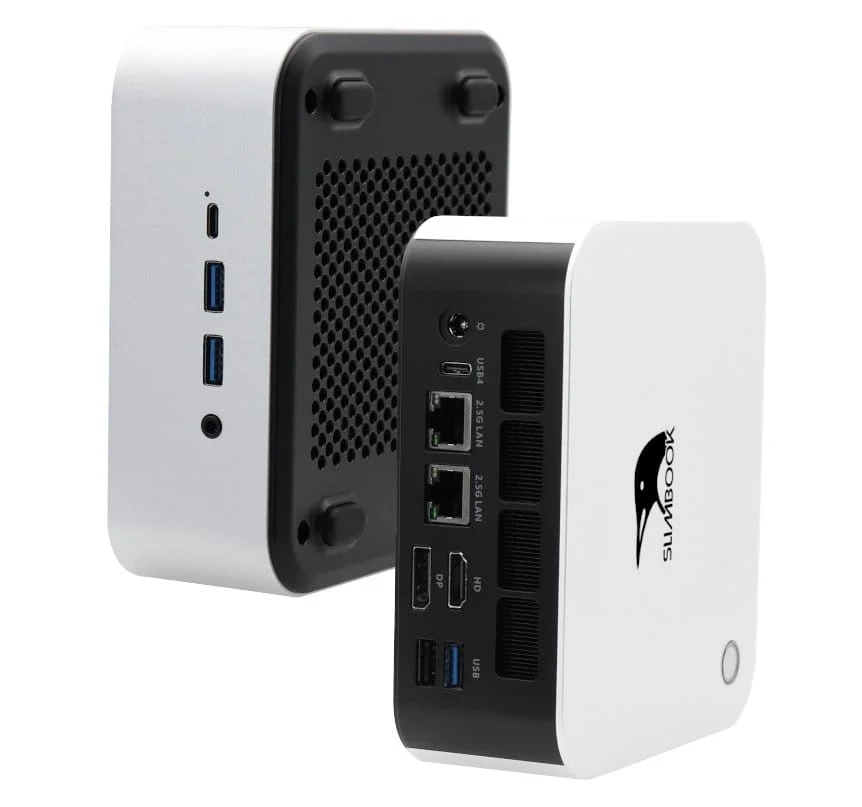
Despite measuring just 130 x 158 x 53 mm, the Slimbook One does not skimp on ports. It features Dual 2.5G Ethernet ports, a boon for home lab enthusiasts or those needing redundant network connections.
You also get Dual USB4 Type-C ports, HDMI 2.1, and DisplayPort 2.0, covering almost any display setup you can imagine.
For storage, the device offers dual M.2 2280 slots (PCIe 4.0 x4). This allows you to install up to 16 TB of fast NVMe storage, making it an excellent candidate for a media server or data-heavy workstation.
Pricing and Availability
The Slimbook One is available for purchase now. The entry-level model with the Ryzen 7 H 255 starts at $699, while the flagship Ryzen AI 9 HX 370 variant commands a premium at $999.
Both base configurations include 16 GB of RAM and a 500 GB SSD. Currently, early adopters can take advantage of a $50 introductory discount.
With this pricing, the Slimbook One enters a competitive ring against rivals like the Beelink SER9 Pro and Minisforum AI X1 Pro, betting big on its Linux-first pedigree and OCuLink expandability to win over power users.