Gmktec has introduced the NucBox K16, a compact mini PC aimed at creators, power users, and gamers seeking desktop-level performance in a small footprint. This launch, confirmed through official release details, highlights Gmktec’s effort to blend high performance with a versatile set of connectivity options, making it relevant for today’s intensive computing needs.
Compared to competitors like Intel’s NUC series or Apple’s Mac Mini, the NucBox K16 stands out with its AMD Ryzen 7 7735HS processor based on Zen 3+ architecture, offering 8 cores and 16 threads capable of delivering clock speeds up to 4.75GHz. Unlike Apple’s M1 or M2 chips, which focus more on energy efficiency, the Ryzen 7 equips the system with gaming-capable integrated Radeon 680M graphics running at 2200MHz, targeting users who need more GPU performance without discrete hardware.

Related Post




The device is configured with 32GB of non-upgradeable LPDDR5X RAM clocked at 6400MT/s, reflecting a move toward faster memory standards but limiting future expansion. Storage options include support for two PCIe 4.0 x4 M.2 2280 SSDs with capacities up to 16TB, though units are shipped with either a 512GB or 1TB PCIe 3.0 SSD as standard. This dual storage capability offers competitive flexibility for heavy workloads or gaming libraries.
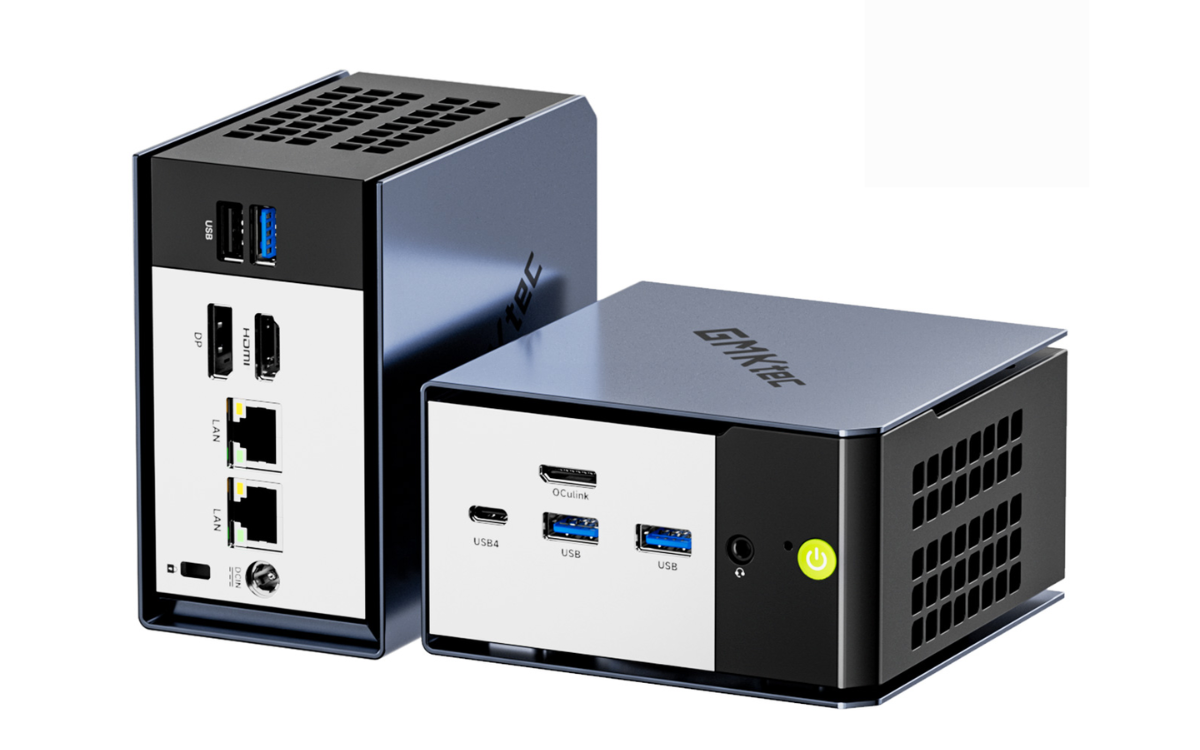
Connectivity is a particular focus with a full-featured USB4 port that supports 40Gbps data transfers, DisplayPort 1.4 with up to 8K@60Hz output, and 100W power delivery for charging connected devices. In addition, an OCuLink interface enables external GPU setups with up to 64Gbps PCIe Gen4 bandwidth, positioning the NucBox K16 as a viable option for users planning to upgrade graphics performance independently—something most mini PCs in this class lack.
The port layout includes on the front panel a power button, two USB 3.2 Gen 2 ports, the USB4 Type-C port, a 3.5mm audio jack, and the OCuLink connector. The rear hosts two additional USB 3.2 Gen 2 ports, HDMI, DisplayPort, dual 2.5GbE LAN ports for faster network throughput, and the DC power input. The system supports up to three simultaneous displays, catering to multitasking or multimedia setups.
Measuring 107 by 111 by 56 mm, the chassis is crafted from CNC-machined aluminum, incorporating dual fans, copper heat pipes, and an internal airflow design. This thermal solution targets maintaining lower temperatures under load, a critical area for compact high-performance systems.
The NucBox K16 enters the market on January 20, 2026, priced at $679.99 for the 32GB RAM and 512GB SSD model and $729.99 for the 1TB SSD version. These prices launch at discounts from MSRP of $899.99 and $949.99, respectively, presenting a competitive value proposition in the mini PC segment.
In the broader market context, this release arrives amid competitive announcements like Beelink’s SER10 mini PC, featuring 10GbE networking and an AMD Ryzen AI HX 470, and ASUS’s ROG GR70, a gaming mini PC equipped with Ryzen 9 and RTX 5070 GPUs. Gmktec’s offering is positioned more toward balanced performance with expansion potential, especially through eGPU setups, than pure gaming power or ultra-high-speed networking.
We believe the NucBox K16’s combination of Ryzen 7 processing, supportive high-speed ports, and external GPU capability will attract users seeking a portable yet powerful desktop alternative. However, the locked RAM and lack of bundled booster GPUs could be a drawback for some gamers and professionals. The pricing incentives at launch add appeal, but potential buyers should weigh these factors against similarly priced alternatives.