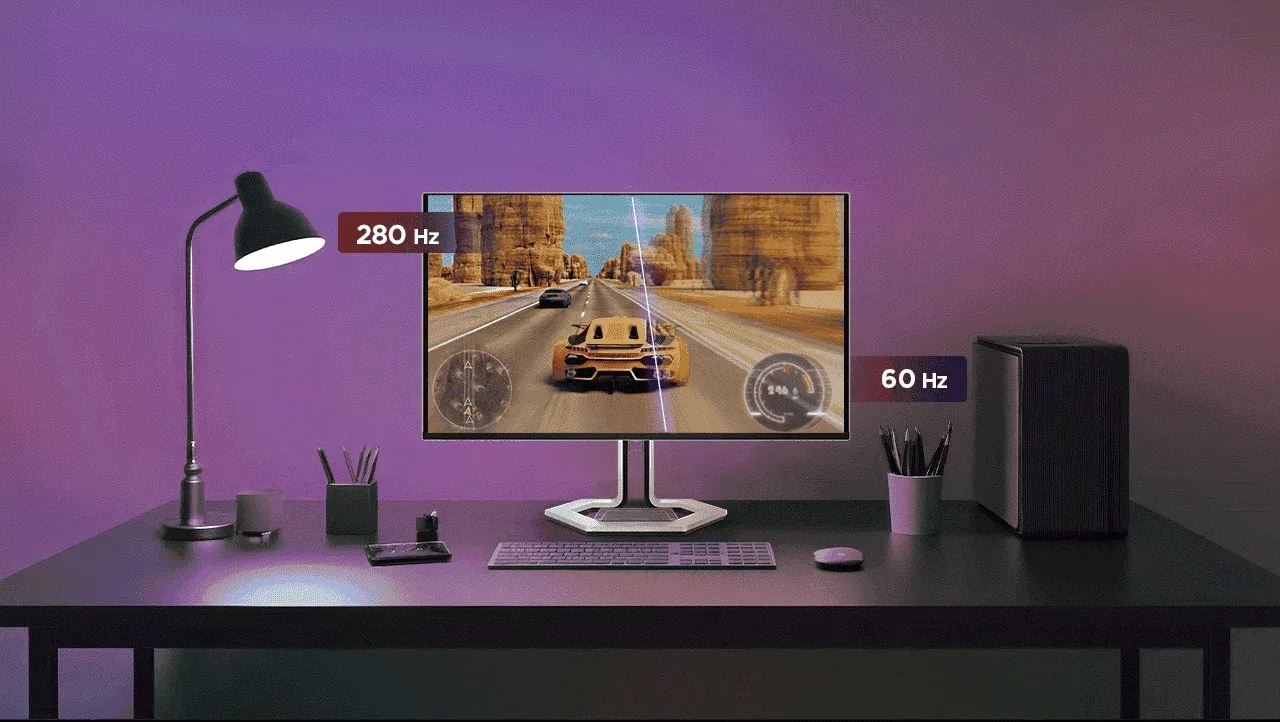
Lenovo has launched the Legion Pro 27Q 10 in China, listing the 26.5 inch gaming monitor for 2,699 yuan, about $387. The headline spec is a QD OLED panel running QHD 2560 x 1440 at a native 280Hz, a combination aimed directly at competitive players who want high refresh without jumping to 4K.
Why 1440p at 280Hz still makes sense in 2026
A 27 inch class 1440p monitor remains a practical target for high frame rate gaming, since many GPUs can sustain triple digit performance at QHD without the heavier tax of 4K. Lenovo lists the panel at 109 PPI in a 16:9 aspect ratio, which sits in the familiar sharpness range for this size category while keeping performance headroom for esports titles.

Related Post





QD OLED strengths, with realistic brightness numbers
Lenovo says the Pro 27Q 10 uses self emissive OLED pixels with quantum dot color enhancement, paired with native 10 bit color. Coverage is listed at 99% for both sRGB and DCI P3, with a 1,500,000:1 contrast ratio. Brightness claims are more conservative than some marketing heavy OLED launches: 250 nits in SDR and up to 1000 nits peak brightness, which aligns with the reality that OLED often wins on contrast and per pixel control more than sustained full screen brightness.
HDR and motion tech aimed at low latency use
The monitor supports DisplayHDR True Black 400 and Dolby Vision. Lenovo rates response time at 0.03ms GtG and pairs the 280Hz refresh rate with AMD FreeSync Premium Pro, VESA Adaptive Sync, and ClearMR 15000 certification. In practical terms, this stack is built to reduce visible blur and tearing while keeping latency low, which is the core reason to buy a panel like this over a slower creator focused OLED.

Burn in anxiety, addressed with familiar safeguards
OLED monitors still raise durability questions for users who mix gaming with desktop productivity, where static UI elements can linger for hours. Lenovo says it includes burn in protection features such as pixel shifting, static image detection, boundary detection, and thermal modulation, all designed to reduce retention risk and improve longevity.
Ports and KVM make it more than a single PC display
Connectivity includes two HDMI 2.1 ports and one DisplayPort 1.4, with Lenovo stating all can run the display at 1440p 280Hz. There is also a USB hub with one USB B upstream and three USB A 3.2 Gen 1 downstream ports, plus KVM support, which matters if you split time between a desktop and a laptop and want one keyboard and mouse setup.
Stand ergonomics and eye comfort features
The stand supports height adjustment up to 135mm, tilt from minus 5 to 22 degrees, swivel up to plus or minus 45 degrees, and pivot up to plus or minus 90 degrees, with 100 x 100mm VESA mounting for arm setups. Lenovo also lists TÜV Rheinland Low Blue Light and Eyesafe Display 2.0 certifications, alongside hardware level DC dimming, targeting long sessions where flicker and eye fatigue become real complaints.
The Daily Tech Lens take
At this price, Lenovo is leaning into a compelling value story: QD OLED contrast and color with a 280Hz ceiling, plus HDMI 2.1 and KVM that broaden the monitor’s role beyond a single gaming PC. The main decision point is risk management, not raw speed. If your day includes lots of static desktop work, you should treat burn in mitigation and warranty support as part of the purchase, not an afterthought. For primarily gaming driven setups that want 1440p at very high refresh, the spec mix hits the current sweet spot without forcing a move to more expensive 4K high refresh OLEDs.