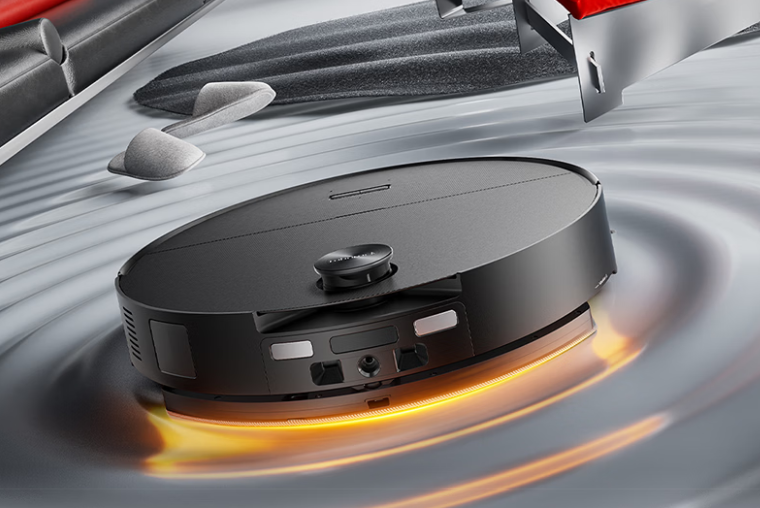
Roborock has released the G30S Pro, a top-tier robot vacuum and mop boasting a maximum suction power of 35,000Pa and several AI-driven enhancements aimed at navigating complex home environments. This launch, sourced from official company announcements, marks a significant technical upgrade designed to improve performance on carpets, around low-clearance furniture, and across multiple floor types.
Compared to its predecessor, the G30S Pro offers a 38% boost in suction capacity, now reaching a peak of 35,000Pa. This positions it competitively against other high-end models like the iRobot Roomba j9+ and Roborock’s own earlier offerings. While the popular Roomba j9+ features intelligent obstacle avoidance and efficient cleaning patterns, Roborock’s latest adds its Chassis Lift 3.0 system—an AI-powered wheel and leg mechanism that allows dynamic height adjustment to glide under obstacles as low as 7.95 cm and climb objects up to 8.8 cm high, such as thresholds and uneven flooring.

Related Post




The cleaning system includes the DuoDivide 0-tangle setup that prevents hair accumulation by incorporating a dual-suspended main brush, side brush, mop, and caster wheel, capable of handling long hair strands up to 40 cm without tangling. Mopping is enhanced with a sonic system operating at up to 4,000 vibrations per minute, applying 14 newtons of pressure and maintaining a 65°C temperature, targeting stains on hard surfaces like tile, wood, marble, and micromarble cement. These specifications show Roborock’s commitment to combining vacuuming and mopping into a seamless clean.
Integration of a hybrid navigation system blending LDS laser mapping, RGB vision, structured light, and auxiliary lighting enables detection of over 280 obstacle types and maintains high navigation accuracy even in dimly lit or cluttered environments. There are dedicated pet-friendly features including recognition, avoidance, photography, two-way video calls, and a pet search mode to minimize disturbances.
The G30S Pro also supports natural language voice commands, allowing users to command the device hands-free via compatible smart assistants or the Roborock app. SmartPlan 4.0 technology identifies individual rooms and adapts cleaning modes automatically, increasing cleaning efficiency on different floor surfaces or high-traffic areas. A robust 6,400mAh battery enables the device to cover larger homes with a single charge and includes fast-charging capabilities.
Complementing the robot is a high-temperature self-cleaning base station that cleans the mop using 100°C boiling water, dries it with 55°C hot air, and manages dust collection, detergent refills, water replenishment, and deodorization. The dock supports up to 60 days of unattended operation and filters expelled air with an E12-grade filter, which aims to improve air quality in the home environment during use.
Pricing begins at 5,499 yuan (approximately $790) for the standard water-tank version and 5,999 yuan (about $862) for the plumbed-in variant, which attaches directly to the home’s water supply for continuous mop refilling. These prices are in line with other premium robot vacuum alternatives, making the G30S Pro a contender that balances advanced features with a competitive price point.
Given the suite of improvements, Roborock appears to be targeting consumers looking for an intelligent, high-performance robot vacuum that manages diverse surfaces and obstacles with minimal user intervention. Its climb-capable chassis, advanced mopping, and comprehensive navigation make it a practical choice for larger, multi-level homes with pets and varied flooring. While competition from brands like iRobot and Ecovacs remains fierce, this model underlines Roborock’s focus on hybrid cleaning devices with AI enhancements.
Potential buyers should watch for regional availability and consider whether the included features meet their specific home cleaning needs, especially in terms of maintenance convenience and room customization. The G30S Pro’s integration of a self-cleaning base station is a valuable addition, likely reducing manual upkeep compared to less automated solutions.