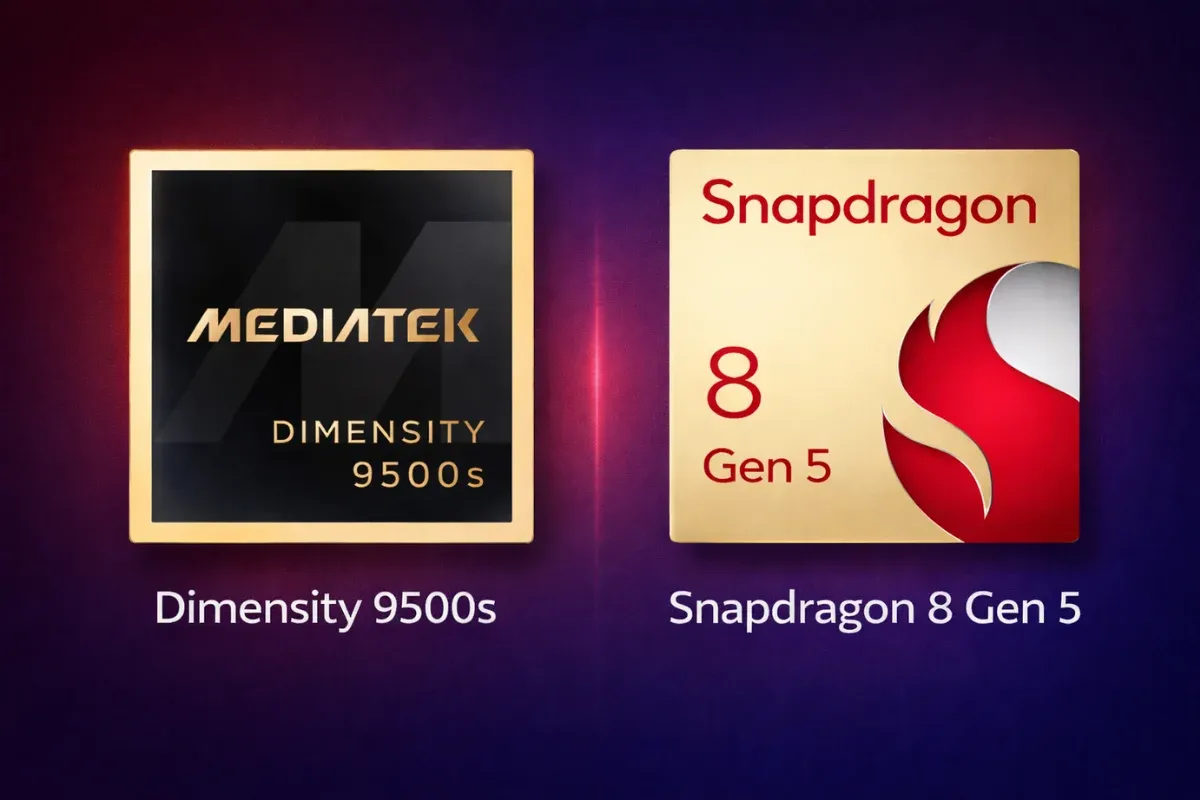
The battle for semiconductor dominance has shifted from pure peak performance to the democratization of flagship power. In a strategic move to undercut Qualcomm, MediaTek has unveiled the Dimensity 9500s, a slightly pared-down version of its top-tier silicon designed to bring elite performance to the sub-$600 smartphone market. Announced this week, the 9500s is positioned as a direct rival to Qualcomm’s Snapdragon 8 Gen 5 (the non-Elite variant), setting the stage for a fierce competition in the “flagship killer” segment that devices like the Redmi Turbo series and POCO F-series dominate.
Context: A Tale of Two 3nm Nodes
Both contenders are fabricated on TSMC’s cutting-edge 3nm process, but the devil is in the details. The Dimensity 9500s utilizes the N3E node, a cost-optimized version of the 3nm lithography that prioritizes yield and efficiency. In contrast, the Snapdragon 8 Gen 5 leverages the slightly more refined N3P node, which theoretically offers marginal gains in transistor density and power efficiency. This fundamental architectural difference suggests Qualcomm may hold a slight thermal advantage before a single benchmark is run.

Related Post


CPU Architecture: Legacy vs. Oryon
The starkest difference lies in the CPU core configuration. The Dimensity 9500s employs a traditional ARM-based layout featuring one Cortex-X925 prime core clocked at 3.73 GHz, supported by three Cortex-X4 performance cores and four Cortex-A720 efficiency cores. While powerful, this “all-big-core” marketing is slightly misleading as it relies on older Cortex-X4 architecture for the secondary cluster, essentially remixing last year’s greatest hits with a new prime core.
Qualcomm, however, has gone fully custom. The Snapdragon 8 Gen 5 ditches ARM’s stock designs for its own 3rd-generation Oryon cores, arranged in a 2+6 configuration. Two prime Oryon cores run at 3.8 GHz, with six performance cores at 3.32 GHz. By eliminating low-power efficiency cores entirely, Qualcomm is betting on the sheer IPC (Instructions Per Clock) efficiency of its custom silicon to handle background tasks without draining the battery. On paper, the Snapdragon’s newer architecture and higher clock speeds give it a clear theoretical lead in raw computational throughput.
Graphics and Gaming: Immortalis vs. Adreno
On the graphics front, MediaTek equips the 9500s with the Immortalis-G925 MP12 GPU. While specific clock speeds remain under wraps, the 12-core configuration suggests a slight reduction in shading units compared to the full-fat Dimensity 9500. It retains hardware-based ray tracing and MediaTek’s Adaptive Gaming Technology 3.0 to manage sustained performance.
The Snapdragon 8 Gen 5 counters with the Adreno 840 GPU. Historically, Adreno GPUs have held an efficiency lead in emulation and sustained driver support, a critical factor for mobile gamers. With the full suite of Snapdragon Elite Gaming features, Qualcomm likely retains the edge for title optimization, though the raw rasterization gap between the two companies has narrowed significantly in recent years.
The AI and Connectivity Divide
The NPU (Neural Processing Unit) battleground is less about raw TOPS (Trillions of Operations Per Second) and more about ecosystem support. The Dimensity 9500s integrates MediaTek’s NPU with support for “agentic AI”—systems that can autonomously act on user intent. Qualcomm’s Hexagon NPU makes similar promises but benefits from a more mature developer stack in the West.
Connectivity reveals a split philosophy. Qualcomm wins on cellular speeds, supporting the newer 3GPP Release 18 standard with up to 10 Gbps peak download speeds on 5G. MediaTek, however, claims the Wi-Fi crown with peak speeds of 6.5 Gbps via Wi-Fi 7, surpassing Qualcomm’s 5.8 Gbps cap. For users relying on home fiber over 5G data plans, the Dimensity chip might actually feel faster in daily usage.
The Daily Tech Lens Verdict
While we await real-world benchmarks from impending devices like the Redmi Turbo 5 Max, the preliminary data suggests a clear hierarchy. The Snapdragon 8 Gen 5 appears to be the superior piece of silicon, benefitting from newer custom cores and a more advanced manufacturing node. However, the Dimensity 9500s is not trying to win on pure specs; it is trying to win on value. If MediaTek can offer 90% of the Snapdragon’s performance at 70% of the cost to manufacturers, we expect 2026 to be flooded with highly capable, affordable flagships powered by the 9500s. For the budget-conscious enthusiast, the MediaTek chip is the one to watch.