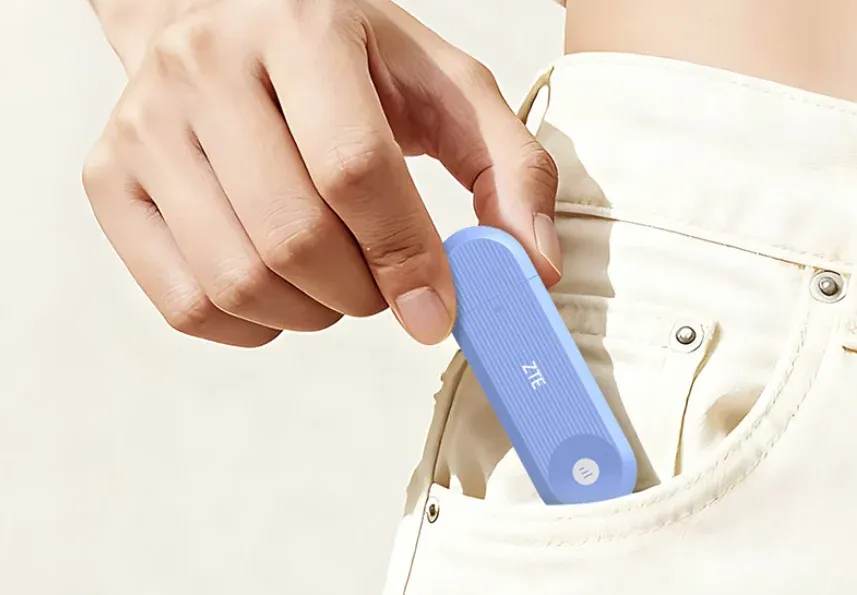
The promise of affordable 5G hardware has largely remained unfulfilled until now, with most dedicated mobile hotspots still costing upwards of $200. ZTE is aggressively undercutting this market with the release of the F40, a portable Wi-Fi dongle that leverages the new “RedCap” (Reduced Capability) 5G standard to hit a starting price of just 179 yuan ($26). This device signals a shift from high-power, expensive 5G modems to efficient, purpose-built silicon designed for broad adoption rather than raw speed records.

Understanding the “RedCap” Trade-off
The F40 is not a standard 5G modem; it is built on the 5G RedCap architecture. This standard—defined in 3GPP Release 17—strips away the unnecessary complexity of full 5G to serve mid-tier IoT and consumer devices. While it sacrifices maximum throughput compared to a flagship smartphone, ZTE claims the F40 delivers a 50 percent speed improvement over traditional 4G LTE and a 70 percent reduction in latency. Critically for a portable device, RedCap modems consume 10 to 20 percent less power than their full-fat 5G counterparts, mitigating the heat issues that often plague compact cellular dongles.

Related Post


A Dual-Interface Travel Solution
Physically, the device is a masterclass in minimalism, weighing 34 grams and measuring just 104mm in length. It eschews the internal battery found in traditional “pucks” like the Netgear Nighthawk, relying instead on USB power. ZTE has implemented a clever dual-interface design featuring both USB-A and USB-C connectors. This allows the unit to plug directly into a laptop for a tethered, wired network connection, or into a wall brick/power bank to function as a standalone Wi-Fi hotspot.
Once active, the F40 broadcasts a dual-band Wi-Fi 6 signal capable of supporting up to 16 simultaneous connections. This density is sufficient for a small team of remote workers or a family road trip, managing a mix of laptops, tablets, and handheld consoles.
Connectivity and Carrier Support
The hardware is available in two distinct configurations. The base model relies on eSIM functionality, while the slightly more expensive 219 yuan ($31) variant includes a physical nano-SIM slot. The latter is the only viable option for international importers, as it allows for carrier flexibility. Domestically in China, the device supports seamless dual-network switching between China Mobile and China Telecom, a feature essential for maintaining uptime in rural dead zones.
Pricing and Import Viability
At $26 for the base model and $31 for the SIM version, the F40 is effectively disposable tech. However, US buyers must exercise caution regarding frequency bands. As a device built for the mainland Chinese market, its support for US 5G bands (specifically n41, n71, or mmWave) is likely non-existent or severely limited. It will likely default to 4G LTE on networks like T-Mobile or Verizon if it connects at all.
The Daily Tech Lens Verdict
The ZTE F40 proves that 5G technology has matured enough to become a commodity. While this specific SKU is likely not the right purchase for a Chicago-based commuter due to band incompatibility, the underlying hardware platform is a win. We expect to see rebranded versions of this RedCap architecture hitting Western markets from OEMs like TP-Link or Netgear later this year. Until then, it serves as a stark reminder that staying connected does not have to cost hundreds of dollars.